Readings: 1 Kings 3:4-15 | Ephesians 1:3-14 | Luke 2:40-52
Text: Luke 2:40-52, Ephesians 1:3-14
“You’re not ready for that.” We usually don’t want to hear that. It’s the space in between how we perceive our own abilities and where an elder or an authority sees where we are. Youthful ambition only makes this humbling harder to hear. Like Luke Skywalker with Yoda on Dagobah, or Bruce Wayne training with Ra’s al Ghul, we don’t yet understand the process by which we mature is long, tedious, and the full picture is only evident in hindsight.
Strange as it may sound, even the Lord Jesus had to mature (albeit not in so theatrical a way as the examples above). The Lord Jesus “grew and became strong” (Luke 2:40); He “increased in wisdom and in stature and in favor with God and man” (Luke 2:52).
His body grew and developed, His mind also increased in knowledge and understanding. Although He was God in the flesh, He was not ready to teach or give signs of the Kingdom of God as a child. The eternal and infinite Son of God humbled Himself and became a servant, as St. Paul explains afterward:
“5Have this mind among yourselves, which is yours in Christ Jesus, 6who, though he was in the form of God, did not count equality with God a thing to be grasped, 7but emptied himself, by taking the form of a servant, being born in the likeness of men. 8And being found in human form, he humbled himself by becoming obedient to the point of death, even death on a cross.” (Philippians 2:5-8)
While it may seem loathsome to us to have to go through the humbling we do, it actually is perfectly modeled for us by our Savior. Not only did Jesus have to be fed at Mary’s breast and carried to Egypt and back, but He also had to submit to His mother and adoptive father’s authority. When the Evangelist tells us, “grew and became strong” (Luke 2:40) and that He “increased in wisdom and in stature and in favor with God and man” (Luke 2:52), it was at the feet of His parents. They were the ones who took Him year after year to the Temple to participate in the Passover (even though according to His divine nature, He had presided over the Exodus itself, Exodus 12). As a boy, He needed to sit at the feet of His father and mother and ask the question, “What does this mean?” (Exodus 13:14) and hear the answer:
By a strong hand the Lord brought us out of Egypt, from the house of slavery. 15 For when Pharaoh stubbornly refused to let us go, the Lord killed all the firstborn in the land of Egypt, both the firstborn of man and the firstborn of animals. Therefore I sacrifice to the Lord all the males that first open the womb, but all the firstborn of my sons I redeem. (vv. 14-15)
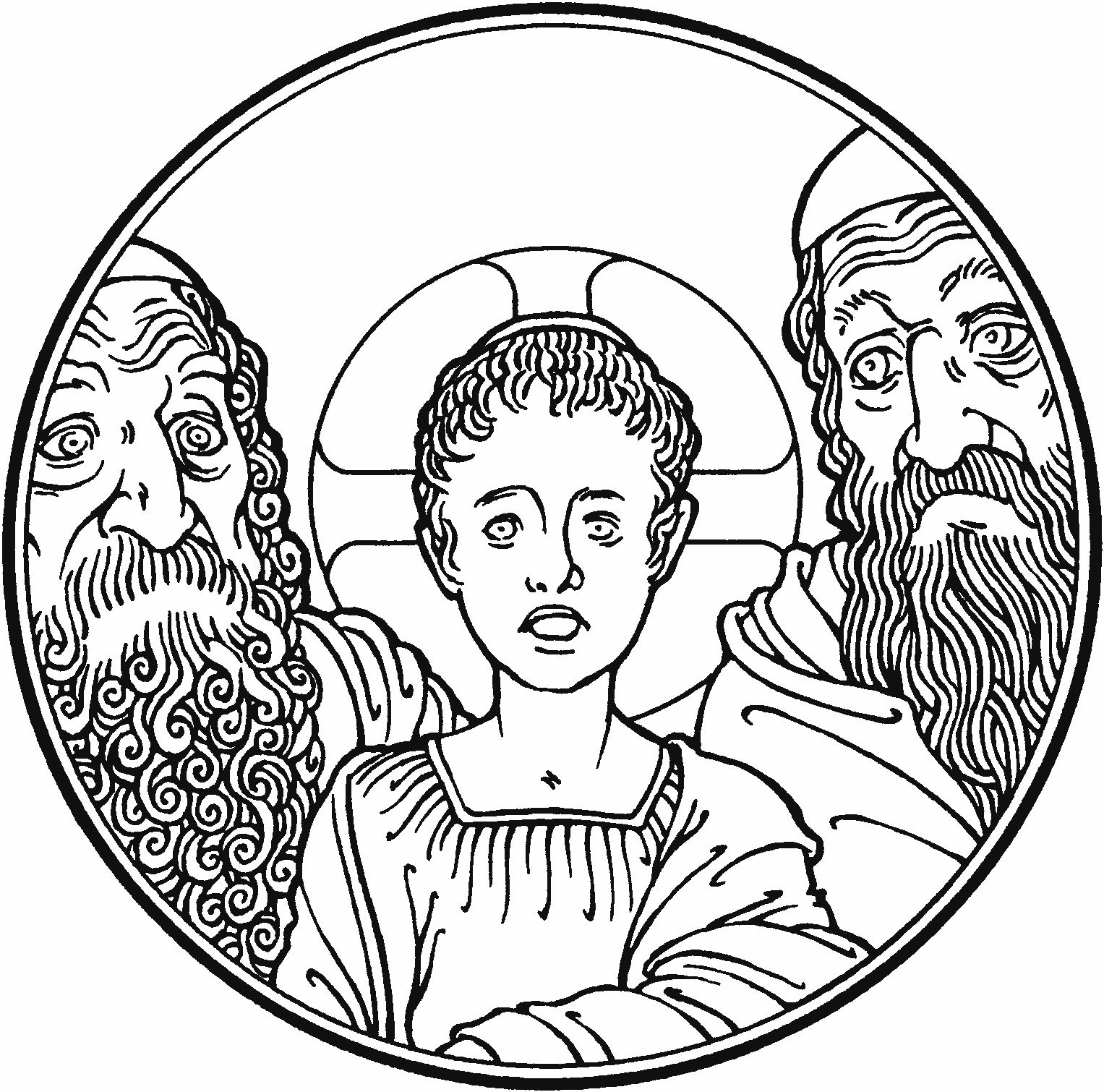
All this growth was necessary along the way. He came to the Temple at 12 years old and was “sitting among the teachers, listening to them and asking them questions. 47 And all who heard him were amazed at his understanding and his answers.” It may be easy for us to assume He already had all the answers, and was just leading them along, but that would betray His full humility as a human being. Jesus did not take shortcuts in His learning or growth in the Word. To put it in terms we’re familiar with, He had to memorize the catechism and recite it fully.
Only through this fully human growth would He then be ready for the point of His Baptism (which we will observe next Sunday). Jesus was and is truly our Brother in the flesh, raised as the spotless Lamb, who would become the Lamb of God. We cannot fully comprehend this, but in His life, we see the unfolding of God’s plan from eternity as the Epistle reading marvels:
3Blessed be the God and Father of our Lord Jesus Christ, who has blessed us in Christ with every spiritual blessing in the heavenly places, 4even as he chose us in him before the foundation of the world, that we should be holy and blameless before him. In love 5he predestined us for adoption to himself as sons through Jesus Christ, according to the purpose of his will, 6to the praise of his glorious grace, with which he has blessed us in the Beloved. 7In him we have redemption through his blood, the forgiveness of our trespasses, according to the riches of his grace, 8which he lavished upon us, in all wisdom and insight 9making known to us the mystery of his will, according to his purpose, which he set forth in Christ 10as a plan for the fullness of time, to unite all things in him, things in heaven and things on earth.
Although it now comes to us as this supernal mystery, it unfolded over the thirty-three years of His life, plus the nine months He dwelt in Mary’s womb. Each of those 12,000 or so days, He lived by faith in the Word of His Father.
He left Jerusalem and remained submissive to His parents, and lived His life free from sin, and the life which each human being has the duty of living before God. The reason why we don’t hear anything about His life in between Jerusalem and His Baptism in the Jordan is because it was what each of our lives should be:
4“Hear, O Israel: The Lord our God, the Lord is one. 5You shall love the Lord your God with all your heart and with all your soul and with all your might. 6And these words that I command you today shall be on your heart. 7You shall teach them diligently to your children, and shall talk of them when you sit in your house, and when you walk by the way, and when you lie down, and when you rise. 8You shall bind them as a sign on your hand, and they shall be as frontlets between your eyes. 9You shall write them on the doorposts of your house and on your gates. (Deuteronomy 6:4-9)
Yet, each of us has failed in our God-given callings—as fathers and mothers, as children, as husbands or wives, as citizens, as children of God. We have loved the Lord our God with all our heart, soul, and strength. We have not loved our neighbors as ourselves. The Commandments of God accuse us and expose our failures. The scars of fractured families, consciences burdened by persistent sins, of pasts that follow us all testify against us.
But Christ is still in His Father’s house, being about the business of God. He is forever the Lamb which God offers up for the sins of the world…for your sins and mine. This is the Gospel for which Jesus came, that He would offer Himself on behalf of our sins. Through Him, God the Father has adopted even us to be called His children. He spoke this promise to us in the water of Holy Baptism: “in Christ Jesus you are all sons of God, through faith. For as many of you as were baptized into Christ have put on Christ.” (Galatians 3:26-27)
And we must also grow in the Father’s house. We begin as newborn babes, fed by the pure spiritual milk of the Word (1 Peter 2:2), and as we are humbled and matured, we grow into perceiving the great mysteries of God.
As a Christian, there are things we are not ready for at first. You can make a newborn babe stumble by loading too deep of paradoxes upon them, like exposing tender seedlings to biting cold.
This is why it is important to growth as children of God that we are in our Father’s house, or more accurately, the Church where His Word is spoken, where we grow in understanding, where our souls are renewed and faith is awakened along the way.
Do we gain “an understanding mind” to go about our vocations, learning to discern “between good and evil” (1 Kings 3:9).
And so do we also go up to Jerusalem to stand “before the ark of the covenant of the Lord” (1 Kings 3:15), that is, in the Holy Communion of His body and blood.
In the Name + of Jesus. Amen.
Leave a Reply