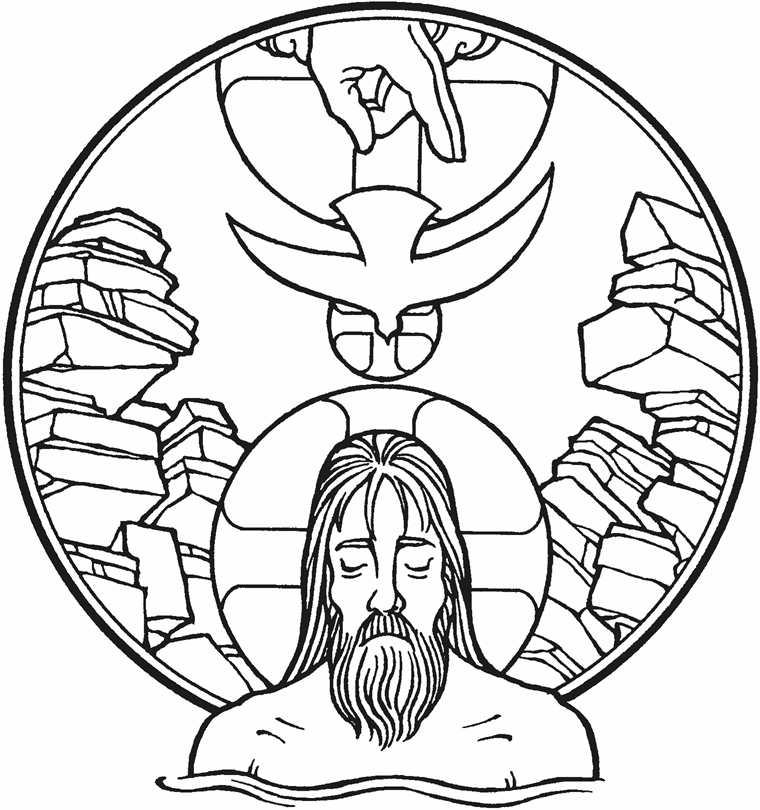
Readings: Isaiah 42:1-9 | Romans 6:1-11 | Matthew 3:13-17
Text: Romans 6:1-11
What is Baptism? If you ask Google, you get a definition like this:
“Search Assist

Baptism is a Christian rite of initiation that typically involves the use of water, symbolizing the admission of a person into the Church. It is often performed by sprinkling, pouring, or immersing in water, and signifies spiritual rebirth and the washing away of sins.”
A local church says on their website, “Baptism is not the means of salvation, but rather a visual expression of the gospel. As John Piper says, ‘If you understand what baptism portrays, you understand what really happened to you when you became a Christian.’…No…baptism will not save you. The Bible is very clear that salvation is only through faith in Jesus Christ.”[1]
This is a very common thought about Baptism found in America, which separates spiritual activity from physical things, as if it were impossible for a spiritual reality to happen in a material action.
Another view sees Baptism objectively as a heavenly mystery:
Baptism is God's most beautiful and magnificent gift. . . .We call it gift, grace, anointing, enlightenment, garment of immortality, bath of rebirth, seal, and most precious gift. It is called gift because it is conferred on those who bring nothing of their own; grace since it is given even to the guilty; Baptism because sin is buried in the water; anointing for it is priestly and royal as are those who are anointed; enlightenment because it radiates light; clothing since it veils our shame; bath because it washes; and seal as it is our guard and the sign of God's Lordship.[2]
With such different descriptions of Baptism, how can one figure out what Baptism actually is?
What better place to go than to Word of God itself?
“1What shall we say then? Are we to continue in sin that grace may abound? 2By no means! How can we who died to sin still live in it? 3Do you not know that all of us who have been baptized into Christ Jesus were baptized into his death? 4We were buried therefore with him by baptism into death, in order that, just as Christ was raised from the dead by the glory of the Father, we too might walk in newness of life. 5For if we have been united with him in a death like his, we shall certainly be united with him in a resurrection like his. 6We know that our old self was crucified with him in order that the body of sin might be brought to nothing, so that we would no longer be enslaved to sin. 7For one who has died has been set free from sin. 8Now if we have died with Christ, we believe that we will also live with him. 9We know that Christ, being raised from the dead, will never die again; death no longer has dominion over him. 10For the death he died he died to sin, once for all, but the life he lives he lives to God. 11So you also must consider yourselves dead to sin and alive to God in Christ Jesus.” (Romans 6:1–11)
The Apostle Paul is in the middle of combating an argument that sees the distinction between a Christian life and the life of the unbeliever as no big deal. Sin? Well, we know that Jesus forgives sinners. We know that He came for the sick, so why not keep living sick so that we can regularly visit the doctor’s office and be healed from our latest malady?
The trouble is that Jesus asks more: To the rich young man, He says,
“If you would be perfect, go, sell what you possess and give to the poor, and you will have treasure in heaven; and come, follow me.” 22When the young man heard this he went away sorrowful, for he had great possessions.” To the woman caught in adultery, He says, “Woman, where are they? Has no one condemned you?” 11She said, “No one, Lord.” And Jesus said, “Neither do I condemn you; go, and from now on sin no more.” (Matthew 19 and John 8).
This is the call for the sinner to repent, turn away, from his or her sins. You cannot remain in them and still follow Jesus.
In Matthew 7, our Lord even vividly portrays the end of a person who thinks repentance doesn’t matter:
“21“Not everyone who says to me, ‘Lord, Lord,’ will enter the kingdom of heaven, but the one who does the will of my Father who is in heaven. 22On that day many will say to me, ‘Lord, Lord, did we not prophesy in your name, and cast out demons in your name, and do many mighty works in your name?’ 23And then will I declare to them, ‘I never knew you; depart from me, you workers of lawlessness.’” (Matthew 7:21–23)
That’s what we said in the beginning of today’s service: “I am heartily sorry for them and sincerely repent of [my sins].” The words of our Lord and Savior teach us that we must be sincere in recognizing that our sins against God and neighbor do deserve punishment, and that we must not “go on sinning so that grace may abound.”
This is something that is widely recognized among even Christians who have a symbolic view of Baptism. But if Baptism is in fact something the Lord gave to show forth our repentance and pledge to do better, then we’d probably have to do it multiple times. Unfortunately, this leaves the contrite soul back to their own fortitude.
But how does God Himself describe Baptism? St. Paul makes the argument, “How can we who died to sin still live in it?” Wait! There is an actual death that happens for the sinner. “3 Do you not know that all of us who have been baptized into Christ Jesus were baptized into his death?” There is more to Baptism than the Christian’s obedience to Christ’s ordinance. It actually is the means by which a Christian receives Christ’s death.
Remember when Jesus was talking to Nicodemus in John 3?
3Jesus answered him, “Truly, truly, I say to you, unless one is born again he cannot see the kingdom of God.” 4Nicodemus said to him, “How can a man be born when he is old? Can he enter a second time into his mother’s womb and be born?” 5Jesus answered, “Truly, truly, I say to you, unless one is born of water and the Spirit, he cannot enter the kingdom of God. 6That which is born of the flesh is flesh, and that which is born of the Spirit is spirit. 7Do not marvel that I said to you, ‘You must be born again.’
Nicodemus was flabbergasted that Jesus said it was necessary to be born again (or born from above, see ESV note on verse 3). In the same way, do we doubt that the death of the sinner could actually happen “by water and the Spirit”? After all, Jesus clearly says that through the same water and Spirit, we are born again.
Baptism actually works that God-desired end in us. God makes it clear that the “soul who sins shall die” (Ezekiel 18:4) Baptism actually delivers Christ’s death and resurrection on behalf of sinners to the person who believes these words. That’s what Paul means by his sentence, “Do you not know…?” To know and take God at His Word is the simple and praiseworthy faith of Mary, who said, “Behold, I am the servant of the Lord; let it be to me according to your word.” (Luke 1:38)
So now the question is, what does having Christ’s death and resurrection benefit us? St. Paul continues:
4We were buried therefore with him by baptism into death, in order that, just as Christ was raised from the dead by the glory of the Father, we too might walk in newness of life.

5For if we have been united with him in a death like his, we shall certainly be united with him in a resurrection like his. 6We know that our old self was crucified with him in order that the body of sin might be brought to nothing, so that we would no longer be enslaved to sin. 7For one who has died has been set free from sin. 8Now if we have died with Christ, we believe that we will also live with him. 9We know that Christ, being raised from the dead, will never die again; death no longer has dominion over him.
Since it is true that Holy Baptism joins us to Christ’s death and resurrection, we are given the assurance that God is working a change within us. The baptized believer is assured that by Jesus’ crucifixion of the “old self” has died, and we have been set free from sin and death! This gives real comfort to the Christian who sees that they have to war against their flesh which is so quick to go on sinning. “in order that the body of sin might be brought to nothing, so that we would no longer be enslaved to sin.” Oh that the body of sin would be brought to nothing! That we would fear, love, and trust in God more and more! That we would love His commandments, flee from all that provokes His wrath, and gladly keep on doing what He commands! This is the power that’s in Holy Baptism.
Just as all Christians know that Jesus’ death and resurrection is the heart of the Gospel and having a personal faith in Him is paramount, so it’s also taught from the Bible that our gracious Lord makes us partakers of this heavenly gift. What was quoted at the beginning is true: “We call [Holy Baptism] gift, grace, anointing, enlightenment, garment of immortality, bath of rebirth, seal, and most precious gift.” Through the water and the Word, God does an amazing work in the baptized quite apart from their own power to make themselves ready. He does all of this using simple water with His almighty Word, which we grow in and appreciate more as we are taught the Christian life.
Thanks be to God for the gift He has given in the Name of the Father and of the + Son and of the Holy Spirit. Amen.
[1] “WHAT WE BELIEVE” www.valleylifechurch.net/what-we-believe/ (Accessed 1/8/2026)
[2] Quote from the Catechism of the Catholic Church, 1216, citing Gregory of Nazianzus
Leave a Reply