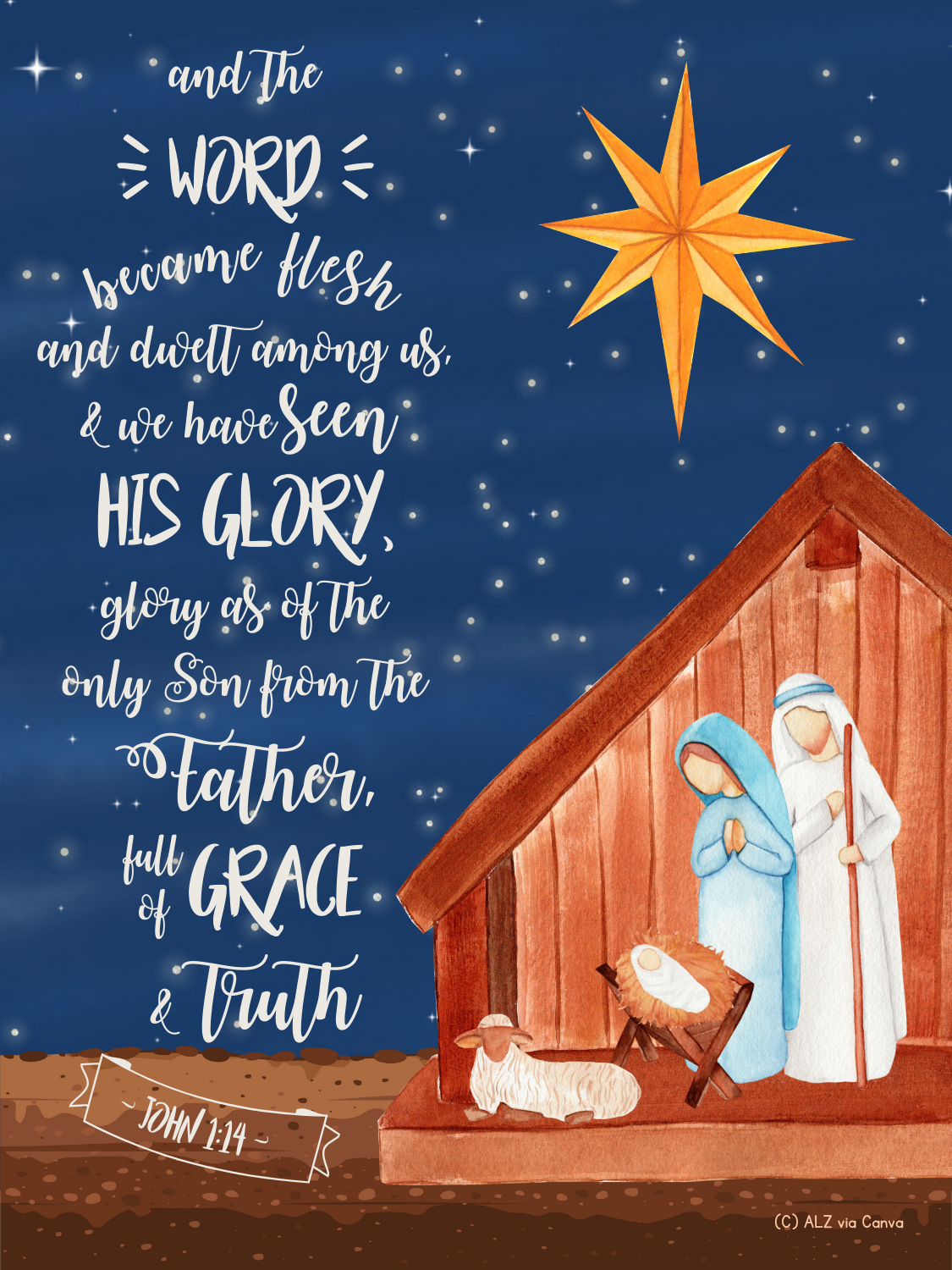
Readings: Isaiah 52:7-10 | Hebrews 1:1-12 | John 1:1-18
Text: Isaiah 52:7-10
We’ve become accustomed to associating this text with the Gospel because of St. Paul’s quoting it in Romans 10:
13For “everyone who calls on the name of the Lord will be saved.”
14How then will they call on him in whom they have not believed? And how are they to believe in him of whom they have never heard? And how are they to hear without someone preaching? 15And how are they to preach unless they are sent? As it is written, “How beautiful are the feet of those who preach the good news!” 16But they have not all obeyed the gospel. For Isaiah says, “Lord, who has believed what he has heard from us?” 17So faith comes from hearing, and hearing through the word of Christ.
In the original context of Isaiah’s ministry, he was being sent with a message that pertained to Israel while they were enslaved in Babylon. They went into exile as prisoners of war, shackled and chained, and living on foreign soil. Since then, exile and Babylon have been used as shorthand not for the original places, but for the alienation of the human race from God. That’s why we hear from Peter and John later:
“Peter, an apostle of Jesus Christ,
To those who are elect exiles of the Dispersion”
                                       (1 Peter 1:1)
     and
2And [the angel] called out with a mighty voice,
     "Fallen, fallen is Babylon the great!
        She has become a dwelling place for demons,
     a haunt for every unclean spirit,
        a haunt for every unclean bird,
        a haunt for every unclean and detestable beast..."
4Then I heard another voice from heaven saying,
     "Come out of her, my people,
        lest you take part in her sins,
     lest you share in her plagues;..."
                                 (Revelation 16:2-4)
So it’s with this context that we hear this proclamation of the good news of Christ’s birth. It’s not just long-awaited post from far away. It is news of deliverance from bondage, salvation from destruction, and the establishment of God’s reign.
In bondage, the slave masters seem to have ultimate sway. So it is with sin. The darkness is so pervasive that we do not have the power to recognize for ourselves. It looks appealing, so that you scarcely have to convince people to call evil good, and slander those who threaten the status quo. Consider the account of Moses while in Egypt:
11One day, when Moses had grown up, he went out to his people and looked on their burdens, and he saw an Egyptian beating a Hebrew, one of his people. 12He looked this way and that, and seeing no one, he struck down the Egyptian and hid him in the sand. 13When he went out the next day, behold, two Hebrews were struggling together. And he said to the man in the wrong, “Why do you strike your companion?” 14He answered, “Who made you a prince and a judge over us? Do you mean to kill me as you killed the Egyptian?” Then Moses was afraid, and thought, “Surely the thing is known.” 15When Pharaoh heard of it, he sought to kill Moses. But Moses fled from Pharaoh and stayed in the land of Midian. And he sat down by a well.
(Exodus 2:11-15)
Yet, later Moses became the instrument of God’s salvation by leading those same slaves out of bondage. So, Christ came to His own, and they did not receive Him. They denied that they had ever been slaves of anyone (John 8:31-36).
Christ’s birth is the announcement of peace to those who had only animosity toward heaven, and fear of God’s righteous judgment.
It is news not just of happiness, but good in stead of the evil that is justly deserved.
It is salvation from God’s enemies: sin, death, and Satan.
And best of all, it is news of God’s reign.
Zion in history was the name for Jerusalem, but just as Babylon in Revelation doesn’t just correspond to the place, Zion is the spiritual Jerusalem which is the dwelling place of God’s people. This is where God has come to establish His reign.
His way of establishing His reign is like that of a warrior:
10   The Lord has bared his holy arm
        before the eyes of all the nations,
     and all the ends of the earth shall see
        the salvation of our God.
“As a warrior is accustomed to make bare his right arm up to the shoulder, that he may fight without encumbrance (exsertare humeros nudamque lacessere pugnan, as Statius says in Theb. i. 413), so has Jehovah made bare His holy arm, that arm in which holiness dwells, which shines with holiness, and which acts in holiness, that arm which has been hitherto concealed and therefore has appeared to be powerless, and that in the sight of the whole world of nations; so that all the ends of the earth come to see the reality of the work, which this arm has already accomplished by showing itself in its unveiled glory—in other words, ‘the salvation of our God.’”[1]
It’s not a reign after the rulers of the world, for His coronation will be with a crown of thorns, and He will not be seated on His throne at first—but nailed to it. Only after He has accomplished this will He sit down at the right hand of God the Father. This is the salvation which all the ends of the earth shall see, for it is God’s battle to recover humanity.
And how He does reign…not in earthly Jerusalem, but from heaven:
16Now the eleven disciples went to Galilee, to the mountain to which Jesus had directed them. 17And when they saw him they worshiped him, but some doubted. 18And Jesus came and said to them, “All authority in heaven and on earth has been given to me. 19Go therefore and make disciples of all nations, baptizing them in the name of the Father and of the Son and of the Holy Spirit, 20teaching them to observe all that I have commanded you. And behold, I am with you always, to the end of the age.” (Matthew 28:16-20)
and He ascended:
6So when they had come together, they asked him, “Lord, will you at this time restore the kingdom to Israel?” 7He said to them, “It is not for you to know times or seasons that the Father has fixed by his own authority. 8But you will receive power when the Holy Spirit has come upon you, and you will be my witnesses in Jerusalem and in all Judea and Samaria, and to the end of the earth.” 9And when he had said these things, as they were looking on, he was lifted up, and a cloud took him out of their sight. 10And while they were gazing into heaven as he went, behold, two men stood by them in white robes, 11and said, “Men of Galilee, why do you stand looking into heaven? This Jesus, who was taken up from you into heaven, will come in the same way as you saw him go into heaven.”
This is our God whom we worship, in the manger with the shepherds, in the house with the Magi, at the Jordan with John the Baptizer, at His entrance into Jerusalem with the Passover pilgrims, and at the cross with John and Mary, and forevermore.
In the Name + of Jesus. Amen.
[1] Keil, Carl Friedrich, and Franz Delitzsch. Commentary on the Old Testament. Peabody, MA: Hendrickson, 1996.
Leave a Reply