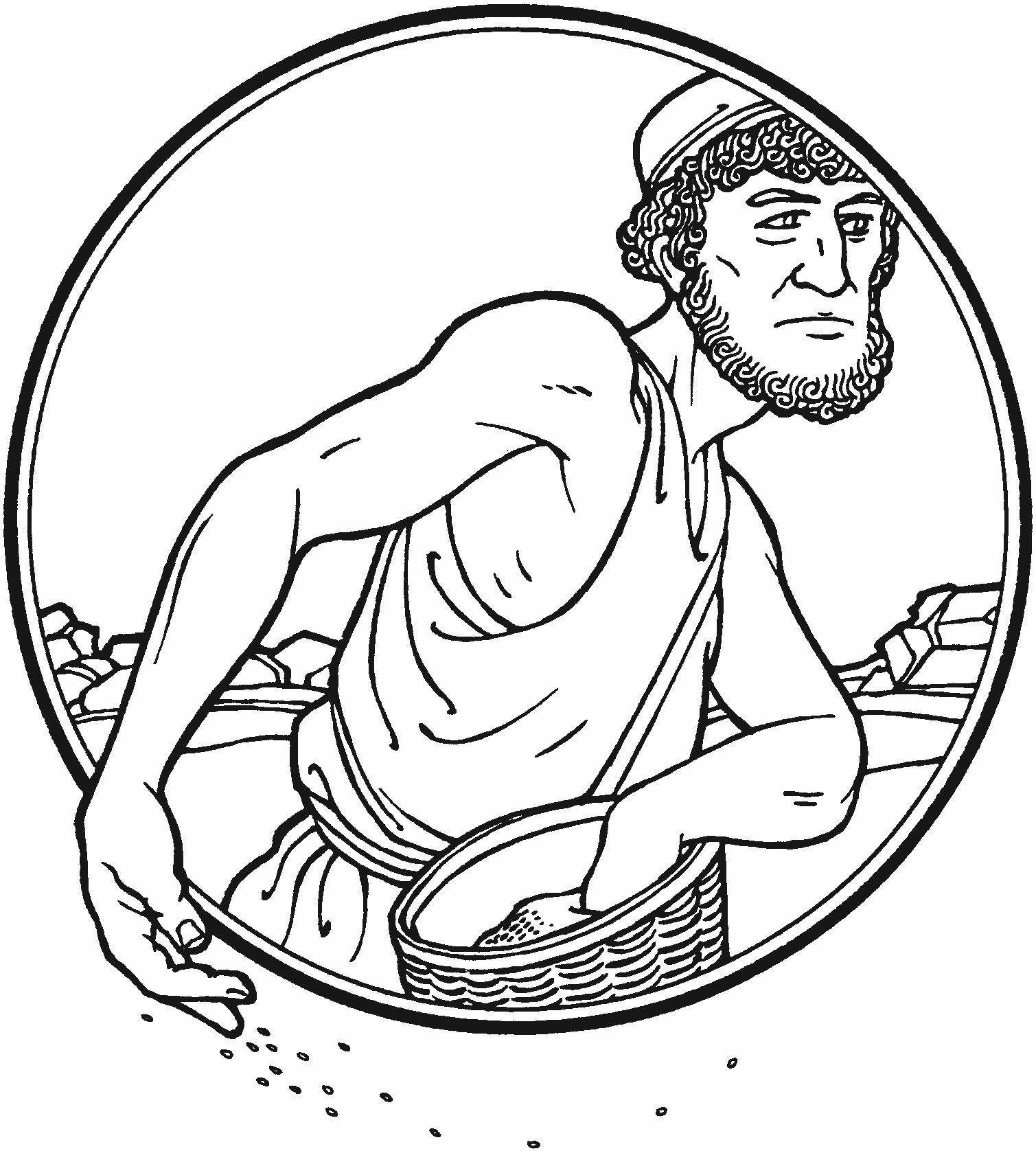
Readings: Isaiah 44:6–8 | Romans 8:18-27 | Matthew 13:24-30, 36-43
Text: Isaiah 55:10-13; Matthew 13:18-23
Sometimes Lutheran Christians are asked about election, in terms of which camp of the Reformation they fit into—Calvinist or Armenian. In case you haven’t heard of these terms, I’ll explain briefly: The Calvinist or Reformed opinion, represented by followers of John Calvin, says that God is sovereign over who is saved and who is condemned (sometimes called double predestination or “once saved, always saved”). In the generation after Calvin, Jacob Arminius, a Dutch theology professor, reacted strongly against this and asserted that all people had the “prevenient grace” to believe or not. Arminius is the patriarch of “decision theology.”
Ever since the 1600’s, there has been a debate between Calvinists and Arminians. These two theological opinions came to America, where there wasn’t a state church to control the matter, and now it’s assumed that all non-Catholics are either one or the other. However, these two passages temper these extremes. Calvin would say that God’s sovereign caused the plants to rise. Arminians would say that all depends on how committed one was in bearing fruit for the Lord, because all of the plants had in some fashion received the Word.
But what does the Lord actually teach?
His Word is powerful and effective. Isaiah 55:10-13 makes this very clear. It made heaven and earth. By it, He corrects and instructs us, as a true lamp to our feet [Psalm 119:105].
For us today, who navigate a sea of human ideas, a torrent of words of both fools and wise, we do well to acknowledge the power of God’s Word. The noise is loud, but God is able to speak clearer, and make Himself heard.
Why does any person come to know Jesus Christ in these days when Jesus is blasphemed as a misremembered man and His likeness is used to approve of what is evil? It is because the Word of God—which we can share as easily as any worthless meme or reel—has the real power of God it has always had. The same Word which “makes the deer give birth and strips the forests bare” (Psalm 29:9) is also the Word which calls out to people who are precious in His sight. Over such as those who hear, the angels rejoice.
But there are other actors in this matter who must be considered. There’s fallen man’s will. There’s also the devil—the liar and murderer of anything that belongs to God.
Who was it who snatched away the Word that was sown? Don’t doubt that you will see spiritual warfare, because the Apostle Peter warns the Church:
“Your adversary the devil prowls around like a roaring lion, seeking someone to devour. Resist him, firm in your faith.” (1 Pet. 5:8-9)
How much more those whom we have seen bruised and battered by Satan’s lies! Yet, we never cease to pray for and love these souls, that they may be saved on that Day. This, we must commit to God’s great love, and venture no more guesses.
We also see the manifold ways that a person, as the sum of all their decisions, lands themselves (and perhaps others) in unbelief. Pay attention to these, because even if we have been snatched from the devil’s jaws, we still have our own flesh to contend with.
What was it that St. Paul said to us in last week’s epistle?
“For I do not understand my own actions. For I do not do what I want, but I do the very thing I hate.” (Rom. 7:15)
This is what each Christian will have to face at one time or another. Your flesh will want something, but the Spirit with the Word will convict you that it is harmful and evil.
In this Parable, our Lord is giving us needed training against the lusts of our flesh. First, beware of an emotional high masquerading as steadfast Christianity, or of any faith that promises to bring secure ease to your life. A person’s faith is like a plant, in that it needs strong roots established so that one’s life is built upon the Rock and not swept away by wind and wave [Matthew 7:24-27].
Second, beware of the demands of this life, because (in our hearts) they can overshadow the power and provision of God. The wrongs can seem too shameful to bring to God. The success of earthly ventures can deplete that first-fruit of our week that we owe to the Lord for the rest He has gifted us to live. The problem here is not the irrelevance or inability of God’s teachings to meet the demands of modern life. Rather, it is our own hearts which idolize these things and fear, love, and trust in them above God.
Third, learn to recognize when the fruit is borne. It will not look the same in each believer. Yet, it is this for which we strive. If we know what to expect from plants when we read the tag, we can know what God can do with His Word in the hands of a faithful Christian. Sometimes the Word will bear tremendously in a given situation, time, or place. Other times and places, the yield will differ. That’s expected. When it is hardest to live faithfully, is when the Word is sown purely, yet it is met with apathy or hostility.
Still, the Word will still bear fruit. The Sower is still sowing. The Word is still coming down and growing in its hearers. So that we might rightly recognize how the Lord does this in our midst, consider the Lord’s Supper. It’s infinitely more than a sentimental moment with Jesus. We, weak and perishing as we are, have the Risen Lord share His Body and Blood with us! This Union with Christ cannot but transform us day by day from our flesh and its lusts into the people renewed after the image of their Creator (Colossians 3:10).
Today, I’d like to employ a spiritual tool that will reorient us before the Sacrament into confessing us for what we are, Christ for who He is, and how daily we have His aid.
Christian Questions with their Answers (Hymnal page 329).
Prepared by Dr. Martin Luther for those who intend to go to the Sacrament.
[The "Christian Questions and Their Answers" desingating Luther as the author, first appeared in an edition of the Small Catechism in 1551, five years after Luther's Death.]
After confession and instruction in the Ten Commandments, the Creed, the Lord’s Prayer, and the Sacraments of Baptism and the Lord’s Supper, the pastor may ask, or Christians may ask themselves these questions:
1. Do you believe that you are a sinner?
Yes, I believe it. I am a sinner.
2. How do you know this?
From the Ten Commandments, which I have not kept.
3. Are you sorry for your sins?
Yes, I am sorry that I have sinned against God.
4. What have you deserved from God because of your sins?
His wrath and displeasure, temporal death, and eternal damnation. See Romans 6:21, 23.
5. Do you hope to be saved?
Yes, that is my hope.
6. In whom then do you trust?
In my dear Lord Jesus Christ.
7. Who is Christ?
The Son of God, true God and man.
8. How many Gods are there?
Only one, but there are three persons: Father, Son, and Holy Spirit.
9. What has Christ done for you that you trust in Him?
He died for me and shed His blood for me on the cross for the forgiveness of sins.
10. Did the Father also die for you?
He did not. The Father is God only, as is the Holy Spirit; but the Son is both true God and true man. He died for me and shed His blood for me.
11. How do you know this?
From the Holy Gospel, from the words instituting the Sacrament, and by His body and blood given me as a pledge in the Sacrament.
12. What are the Words of Institution?
Our Lord Jesus Christ, on the night when He was betrayed, took bread, and when He had given thanks, He broke it and gave it to the disciples and said: “Take, eat; this is My body, which is given for you. This do in remembrance of Me.” In the same way also He took the cup after supper, and when He had given thanks, He gave it to them, saying: “Drink of it, all of you; this cup is the new testament in My blood, which is shed for you for the forgiveness of sins. This do, as often as you drink it, in remembrance of Me.”
13. Do you believe, then, that the true body and blood of Christ are in the Sacrament?
Yes, I believe it.
14. What convinces you to believe this?
The word of Christ: Take, eat, this is My body; drink of it, all of you, this is My blood.
15. What should we do when we eat His body and drink His blood, and in this way receive His pledge?
We should remember and proclaim His death and the shedding of His blood, as He taught us: This do, as often as you drink it, in remembrance of Me.
16. Why should we remember and proclaim His death?
First, so we may learn to believe that no creature could make satisfaction for our sins. Only Christ, true God and man, could do that. Second, so we may learn to be horrified by our sins, and to regard them as very serious. Third, so we may find joy and comfort in Christ alone, and through faith in Him be saved.
17. What motivated Christ to die and make full payment for your sins?
His great love for His Father and for me and other sinners, as it is written in John 14; Romans 5; Galatians 2; and Ephesians 5.
18. Finally, why do you wish to go to the Sacrament?
That I may learn to believe that Christ, out of great love, died for my sin, and also learn from Him to love God and my neighbor.
19. What should admonish and encourage a Christian to receive the Sacrament frequently?
First, both the command and the promise of Christ the Lord. Second, his own pressing need, because of which the command, encouragement, and promise are given.
20. But what should you do if you are not aware of this need and have no hunger and thirst for the Sacrament?
To such a person no better advice can be given than this: first, he should touch his body to see if he still has flesh and blood. Then he should believe what the Scriptures say of it in Galatians 5 and Romans 7. Second, he should look around to see whether he is still in the world, and remember that there will be no lack of sin and trouble, as the Scriptures say in John 15–16 and in 1 John 2 and 5. Third, he will certainly have the devil also around him, who with his lying and murdering day and night will let him have no peace, within or without, as the Scriptures picture him in John 8 and 16; 1 Peter 5; Ephesians 6; and 2 Timothy 2.
NOTE:
These questions and answers are no child’s play, but are drawn up with great earnestness of purpose by the venerable and devout Dr. Luther for both young and old. Let each one pay attention and consider it a serious matter; for St. Paul writes to the Galatians in chapter six: “Do not be deceived: God cannot be mocked.”
In the Name + of Jesus. Amen.
Leave a Reply